Wednesday, March 23, 2011

La Ruta Maya

BELIZE—

La Ruta Maya! Early one morning we headed out to the nearby San Ignacio town at the crack of dawn to experience one of Belize’s most exciting community events, La Ruta Maya. Started in 1998, La Ruta Maya is a four-day canoe race across the country by way of the Macal and Belize Rivers. Participants vary in canoe experience; from international competing professionals to the laid back folks just seeking laughs and memories. The route was once the only means of transportation between the inland and Caribbean Sea regions of Belize. The race also serves as a commemoration of Baron Bliss day, a Belizean holiday in honor of Baron Bliss, who was a traveler that willed two million dollars to Belize (then British Honduras) in the early 1900’s.

With the river banks and the Macal river bridge loaded with shouts and applause, the excitement couldn’t be held in! Hundreds of canoes everywhere: some fast, some slow, some tipping over in the commotion, frantically trying to dump out the water for a 2nd try! We cheered until the very last boat went by and still made it back in time for breakfast.


San Ignacio was bursting with commotion as spectators crammed the lower bridge across the Macal River to send off the canoes in proper Belize fashion

Monday, March 21, 2011

Tropical Ecosystems: In your face!

BELIZE--

As our Spring Break travel week adventures came to a close, the CCSP 2011 crew regrouped, coming from all corners of Belize and Guatemala with stories galore and a recharge of R&R. We were now ready to take on a week of Forest Ecology with Dave Foster (Messiah College) spearheading the way.

Class didn’t spend much time in the classroom this time around. After one lecture at our Nabitunich campus home we were off to Cockscomb Basin Wildlife Sanctuary. Established in 1986, Cockscomb is unique in that it is the only wildlife sanctuary in the world established primarily for the conservation of the Jaguar (Panthera onca). While we didn’t happen to spot any Jaguars in our many hikes, there was much to behold in this astounding tropical patch of the creation. Our accumulative bird list from the whole week consisted of 139 species! Other exciting sightings out on the trail included Brocket Deer, Morlet’s Crocodile, Box Turtles, Gibnuts, and Agoutis. Thanks to David’s heat sensing camera traps, we were lucky enough to catch a Puma on camera! The week was indeed one thrill after another as we experienced the rainforest up close and personal. From scenic overlooks of endless hills densely forested to swimming holes, Cockscomb isn’t a place any of us will soon forget.


During a night hike, Heather Pagelkopf (Northwestern, '12) examines the intricate feather detail of the Common Paraque (Nyctidromus albicollis)


The bizarre Boat-billed Heron (Cochlearius cochlearius) perches over the swamp where it nests during the day, but will prowl the waters for food by night

On our way back from Cockscomb, we stopped in Red Bank at an organic cacao farm to see how cacao (used to make chocolate) is grown in Belize, along with many other traditional Belizean crops. This particular farm also happened to be near to where the Scarlet Macaws (Ara Macao) gathers at this time of year. How does the community incorporate eco-tourism along with their farms? How do these small-scale agriculture operations interact with the nearby rainforest? How do they benefit the community and the Belize market? These were just some of the questions we were able to contemplate and bring to life in the dialogue with the community of Red Bank.

One of the most thrilling moments of the week was the first glimpse of the Puma (Puma concolor) caught on David Foster's heat-sensing camera trap! Pumas are actually more rare than Jaguars in Cockscomb

The class wrapped up back home in the nearby mountain forests and on campus with a few more lectures to encapsulate the course and presentations from student projects that were completed throughout the week. Projects were diverse, ranging from leaf cutter ant studies, to fungi, to epiphytes, to of course birds. With the satisfaction of our final night of class looking back at our behemoth bird list, completed projects and field journals, countless laughs and memories, along with some sore muscles, Nabitunich was soon fast asleep with dreams of Jaguars prancing in our heads.

As we studied so many plants, we just had to try the wild blueberries we stumbled across in Mountain Pine Ridge forest reserve


A view from the top: The journey was just as inspiring as the photo

Saturday, March 12, 2011

A Language that can Make Us Whole


Belize-


A Language that can Make Us Whole: Reading and Writing Environmental Literature.

Between the wisps of swaying branches on a sunny pastoral afternoon in Belize, Tityra birds murmur in the branches while the stories from the week still resonate in our minds. Stories by Henry David Thoreau Rachel Carson, Edward Abbey, Annie Dillard, Wendell Berry, and our very own professor Fred Bahnson himself. These are just some of the many story tellers who took us on our literary journey this week. Fred brought much to the course, coming from four years of agricultural ministry at “Anathoth Community Garden” in North Carolina, he challenged us to realistically see Christian Shalom as an agrarian community.

Our mid-week excursion took us to Mountain Pine Ridge forest reserve, where we encountered a flood of both inspiration and scenic wonder that fused into class

As we entered into the week with an exuberant Monday, it didn’t take long to tap into the reservoirs of thoughts that we compiled two weeks ago during Reading Week. After that full week of reading, the discussions that now followed brought the text to life. From land ethics to agrarian visions, from stories to essays to poetry, Fred facilitated the way. Utilizing a variety of writers, as well as daily reflection on the Psalms, we listened, discussed, and even argued. Through all of it, we sought a language in the shape of God’s kingdom come, on earth as it is in heaven. How are we to resist what Bill Mckibben refers to as society’s dominant theme of “running Genesis backward, decreating”? Perhaps this plethora of literature contains glimpses of answers that we must prayerfully sift through. Perhaps the writings and words we’ve composed throughout the week do. Words, after all, shape who we are. Words shape stories, and as Barry Lopez reveals to us, “Sometimes people need a story more than food to stay alive”.


Night classes around a bonfire were exquisite venues for story telling and even a bit of good 'ol Irish fiddle! (Thanks to Fred's fine-tuned skills)


Saturday, March 5, 2011

Digging into the Biblical Story

God and Nature 1 with Sylvia Keesmaat challenged us to think about the stories that shape us. What places in our culture tell us stories? What do these stories tell us about the earth’s value and our relationship to the earth? What does God’s story tell us?

From the first day of class, the framework of the Biblical story shaped our reading of scripture. Everyday we read scripture texts from across the Biblical story to see how different themes can be traced throughout the scriptures. Themes of creation’s voice, misuse of creation through idolatry and empire, and God’s plan of Sabbath and jubilee brought us a more complete understanding of what it means to be faithful Christians. We desire to be shaped by God’s story instead of the stories told to us by our culture. And with God’s grace, we will continue to dig in the garden in anticipation of the end of the story, the new heaven and the new earth!

Tuesday, February 22, 2011

Reading Week: Soaking the Sponge

Belize-

After Stream Ecology, it was great to mix up the schedule a bit. During Reading Week/Environmental Literature pt. 1, students could chip away at the reading list at will in preparation for Environmental Literature pt. 2, Forest Ecology and Marine Ecology. Just a book, a hammock, the chatter of the Kiskadee birds, and a cup of tea and we were set for the day! And how satisfying it was, after our brains were sponges all day, to gaze over the golden lighted fields and forests in the evening in reflection. Many students found this week a good time to catch up with their host families where they spent last weekend in the local village of Succotz, for dinner, enjoying Succotz home cooking and baking cookies with their Belizean friends. The Student Life Coordinators here at CCSP had plans of their own, and were excited to offer a variety of life skill hobbies throughout the week. With plenty of new material to chew on, and a full week of recharge, we now haste the coming of God and Nature pt. I.


Monday, February 21, 2011

Valentine's Day at Nabitunich

Belize-

Valentines day here at Nabitunich was nothing short of a heartthrob!
The 2011 calendar was on our side as it plopped this special day right in the beginning of the week. Love was in the air, from bright shining smiles to Valentines being hid here and there to the first sight of a cashew fruit on our cashew tree. And what can CCSP dish out day or night rain or shine? Oh yes, celebrations! We started the night with a very insightful love language test, which taught us about ourselves as well as the community. Who loves hugs? Who loves gifts? Quality time? Seems like a must for any community! Following the test, Impersonation Speed Dating (ISD) was underway. With characters such as Donald Duck, Darth Vader, Scooby Doo, Gollum, Hermione, and Patrice (a local farm dog), many speed daters found their “impersonation”-match. This match tragically reached the end of the love tale after we enjoyed ice cream and brownies to close the night. The lingering conversations basked in memories of our own favorite Valentine’s days in years past.


At times, composure was hard to come by

Wednesday, February 16, 2011

Flowing Streams, macroinvertebrates and more!

Belize-

Stream Ecology encouraged us to learn about the importance of fresh water! Especially, to discuss our responsibility towards streams, given the fact that streams are so important for supporting life and yet make up a small percentage of the total amount of fresh water on earth!

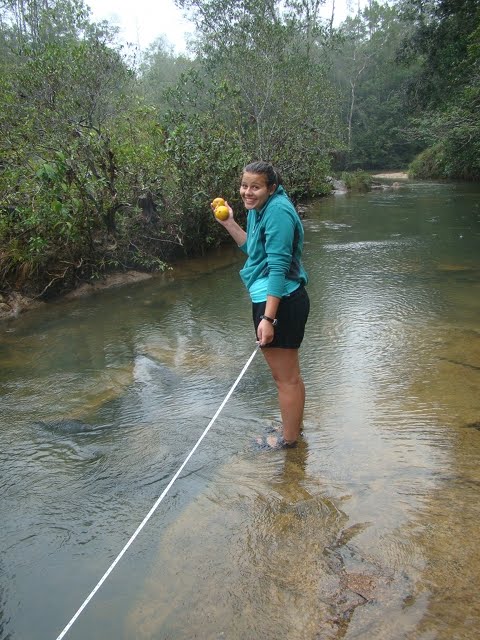
Stream flow measurements at Privassion Creek

With this in mind, we headed out to the field to discover for ourselves what the water quality is like in Belize’s flowing streams.

Testing the pH of a stream

Our first day in the field involved learning how to assess the habitat quality of the streams, as well as collecting organisms for a biological survey and testing for chemical variables. A highlight of the day was visiting an impressive cave with a stream flowing through it. Our professor, Mike Guebert from Taylor University, made sure we appreciated the cave for more than it’s beauty, but also for a rare geological feature found inside! The cave is a limestone ceiling which sits directly on the granite bedrock of the stream basin; it is unusual to see two types of rocks, formed over a 100 million years apart, sitting right on top of each other!

Searching for macroinvertebrates and other organisms

Thanks to Ashley Rosenberger of CCSP, we all learned to find and identify intriguing macroinvertebrates that live in streams. The most commonly found macroinvertebrates are insect larva which are so important to the health of streams and can tell us a lot about the water quality of the stream!

Megaloptera- a macroinvertebrate!

On our final fieldtrip we discovered more amazing streams- clear, rushing streams with fast riffles and deeper pools where we could watch cichlid fish swimming, and where we swam too! We enjoyed the bubbling water as we took our water quality data. To end the day we headed to Five Blues, a national park which has a beautiful blue lake, surrounded by a limestone landscape called Karst. After hiking through the thick forest surrounding the lake, the water was refreshing!

More stream studies!

At the end of the week students analyzed the stream quality data and presented their findings. While learning all week that the health of a stream is determined by the health of all the land that drains into that stream (the watershed), we began to wonder how healthy the streams and rivers back home are, and what we can do once we return home to ensure a healthy watershed!